
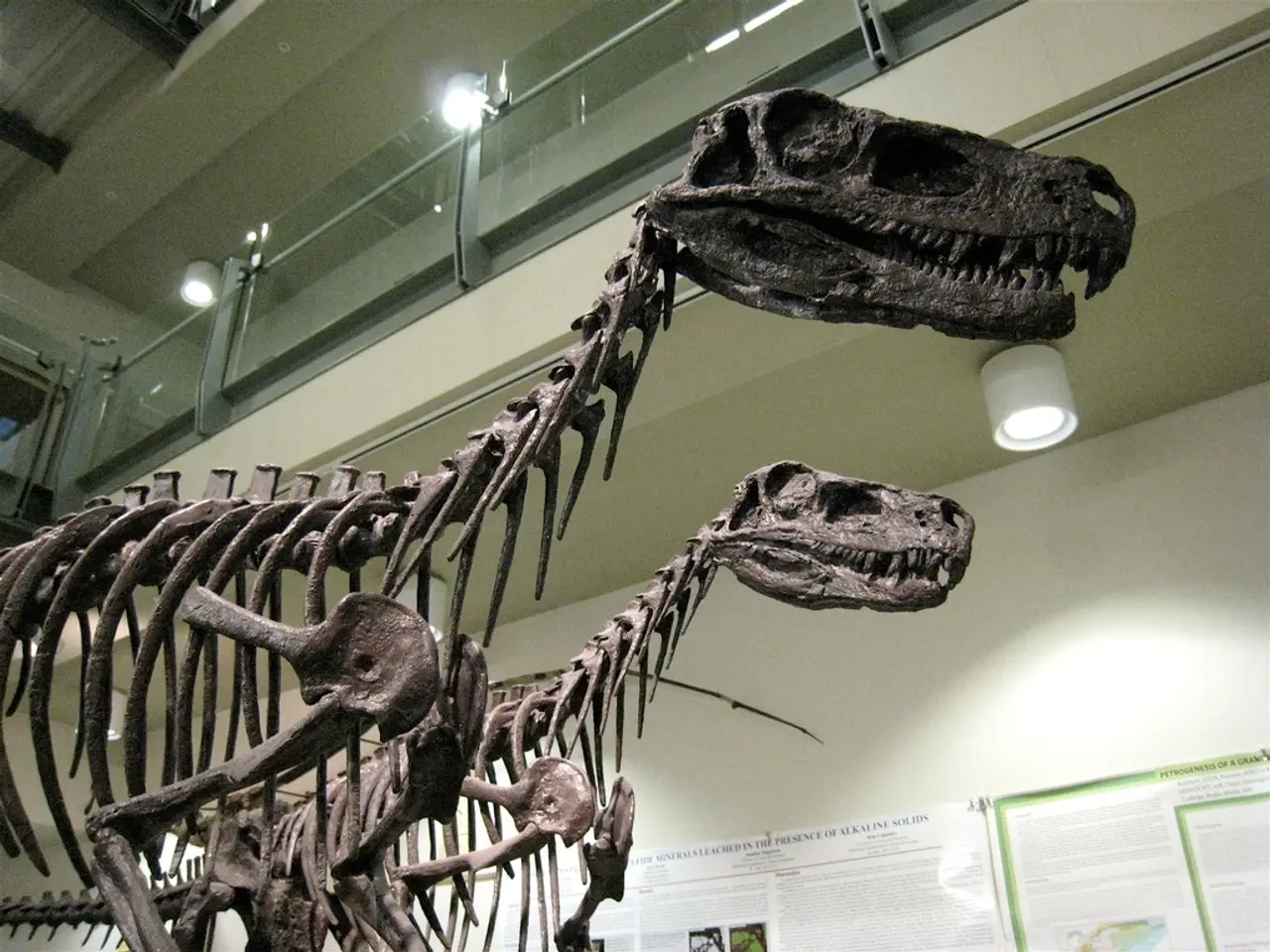
Affluent Buyers Grab T-Rex Fossils, Sidelining Scientists in the Process
In the world of Tyrannosaurus Rex fossils, a significant portion of these prehistoric treasures are locked away in private collections, far from the reach of scientists and research institutions. A recent study published in Palaeontologia Electronica has shed light on this issue, highlighting how the commercial fossil collecting industry is hindering the scientific record of Tyrannosaurus Rex.
Approximately 44% of scientifically valuable T. Rex fossils are estimated to be privately or commercially owned instead of being housed in public or accredited institutions. This means that over half (71 specimens) of the 141 scientifically useful T. Rex fossils known to exist are inaccessible to researchers, limiting detailed study and potentially leading to the loss of critical contextual information essential for paleontological research.
Commercial outfits have discovered nearly 2.4 times more T. Rex specimens than public institutions since the early 1990s. However, only one out of the five T. Rex fossils sold at auction was purchased by a museum. The high prices of T. Rex fossils, such as "Sue" in 1997 for $8.36 million and Stan in 2020 for a record-shattering $31.8 million, make them inaccessible for most museums, unless a philanthropic donor steps in.
The luxury fossil trade not only negatively impacts the scientific record but also leads to fragmentation. Private owners may restrict research access, sell specimens piecemeal, or remove contextual data that is vital for scientific interpretation. High-profile fossil sales, such as those fetching tens of millions of dollars, underscore how lucrative but detrimental this market can be for public paleontology.
Ken Griffin, a notable collector, purchased the Stegosaurus fossil dubbed "Apex" for $44.6 million in 2021, making it the most expensive fossil ever sold. However, Griffin loaned Apex to the American Museum of Natural History in New York, where it is currently on display, offering a glimmer of hope for public access to these valuable specimens.
Scientists are particularly concerned about the lack of access to juvenile and subadult T. Rex fossils. These specimens, which make up the least understood phase of T. Rex development, are often the ones being bought privately or commercially. Without access to these specimens, scientists can't build a reliable picture of how T. Rex grew, matured, or even whether the species showed sexual dimorphism.
Carr's study takes issue with the trend of publishing peer-reviewed studies based on privately owned fossils. The scientific value of a fossil decreases if future teams cannot access it, as replicability is crucial in science. The issue of commercial fossil collecting is not a fringe issue in the world of Tyrannosaurus Rex fossils; it's a pressing concern that threatens to inhibit our understanding of these awe-inspiring creatures.
[1] Carr, T. D. (2020). The Tyrannosaur Specimens in Private Hands: A Survey of the Collection and Its Impact on Science. Palaeontologia Electronica, 23(4), 1-25.
[2] Currie, P. J. (2018). Tyrannosauridae. In The Dinosauria (6th ed., pp. 577-587). University of California Press.
[5] National Science Foundation. (n.d.). Fossils: A National Treasure. Retrieved from https://www.nsf.gov/discoveries/disc_summ.jsp?cntn_id=116716
- Gizmodo reported on a study published in Palaeontologia Electronica that highlights the issue of privately owned T. Rex fossils, hindering the scientific record.
- science, technology, and education-and-self-development websites have covered the issue of commercial fossil collecting and its impact on Tyrannosaurus Rex research.
- In the world of Tyrannosaurus Rex fossils, the commercial fossil collecting industry is a pressing concern that threatens our understanding of these prehistoric creatures.
- General news outlets have reported on the lucrative yet detrimental luxury fossil trade, including high-profile fossil sales like Sue and Stan, which were sold for millions of dollars and are now inaccessible to most researchers.
- Finance news sites have discussed the high prices of T. Rex fossils, such as the record-shattering $31.8 million sale of Stan in 2020, making them inaccessible for most museums unless a philanthropic donor steps in.
- Lifestyle magazines have featured articles on exclusive fossil collections, making the public aware of the problem of limited access to scientifically valuable T. Rex fossils.
- Casino-and-gambling websites may have advertisements for fossil auctions, where millions of dollars are spent on T. Rex fossils, contributing to the fragmentation and loss of contextual information essential for paleontological research.




